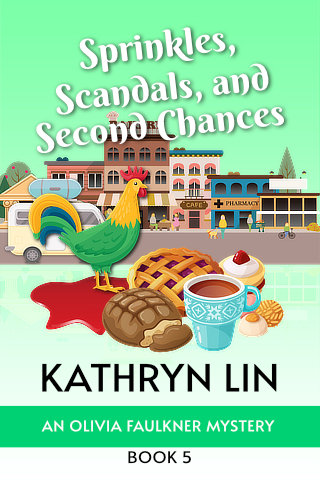
Sprinkles, Scandals, and Second Chances
Book 5 of Olivia Faulkner Mysteries
Forty years. That’s how long Olivia Faulkner has been searching for her little sister.
Now she has a phone number, a name she doesn’t recognize, and a woman arriving at the airport who doesn’t remember being stolen.
Piper is alive. She goes by Patricia now, with a husband, children, and a whole life built on a lie she never knew she was living. When she arrives in Grand Arbor for a ten-day visit, Olivia pulls out their mother’s cherry almond scone recipe and hopes that a shared kitchen can bridge four decades of silence.
But reconnecting with a stranger who shares your blood is harder than any recipe Olivia has ever followed. And when a newcomer to town turns up dead in a rental cottage, Olivia is pulled into an investigation that uncovers something rotten at the heart of Grand Arbor’s most trusted institutions.
Now Olivia is torn between the sister she finally found and a killer hiding behind a familiar face. The reunion she waited a lifetime for is slipping through her fingers, and the truth she’s chasing may cost her the only thing that matters more than answers: a second chance at family.
buy now
Excerpt
I had baked forty-seven cherry almond scones by the time Carly arrived at six, and I was reaching for the almond extract again.
“Liv.” She stopped in the kitchen doorway, still pulling her coat off one arm. “That’s the third batch.”
“Fourth.”
“Fourth.” She draped the coat over the back of my office chair, grabbed an apron from the hook, and tied it around her waist with the efficiency of someone who’d done it ten thousand times. “And you don’t even like cherries.”
“They’re Mom’s recipe.” I pressed the cutter into the dough with more force than the scones deserved. “Patricia might remember them. Kids remember tastes, right? Even from when they were little?”
Carly’s face softened. She came around the steel worktable and bumped her hip against mine. “She’s going to love them.”
“You don’t know that.”
“Everyone loves your mom’s cherry almond scones.”
“You just said I don’t even like cherries.”
“That’s because you’re weird.” She reached past me for the bag of sliced almonds. “Have you thought about what else she’ll want to eat? What if she doesn’t like bear claws?”
I stared at her.
“Everyone likes bear claws,” Carly said, less certainly. “Right?”
Two days. In two days, the sister I had lost at a carousel forty years ago would walk off a plane from Vancouver and into my life. Not the seven-year-old with twin braids and a gap-toothed grin and a red polka-dot birthday dress. A forty-seven-year-old woman named Trish who taught third grade and had twins of her own and a husband named David and a house with a garden she couldn’t keep alive. A stranger who shared my blood and my parents and nothing else.
I wiped my hands on my apron and slid the fourth batch into the oven. The kitchen was warm and flour-dusted, the industrial mixer still humming from the bear claw dough I had set to rise at four-thirty. Butter and sugar and almond extract hung in the air, and if I closed my eyes I could almost hear my mother’s voice telling me I was overworking the dough.
She would have been right.
“The scones are for the welcome,” I told Carly. “Not for stress.”
“Uh huh.” She poured coffee from the carafe and handed me a mug without being asked. “And the two batches of croissants you made yesterday? Also for the welcome?”
I took the coffee. “I like to be prepared.”
“You like to control things you can’t control by baking until the flour runs out.” She sipped from her own mug. “But I love you, so I’m going to let that slide.”
The front bell chimed at seven sharp, and within minutes the cafe filled with the usual morning crowd. Mr. Schumacher at his corner table with his black coffee and blueberry muffin. Two university students splitting a cinnamon roll and pretending to study. Austin Parma ducked in for his usual box of donuts. He asked how I was holding up and squeezed my shoulder on his way out.
Then Maude and Trixie arrived.
Trixie’s stage whisper carried through the glass before the door even opened. “Do you think she’s made the scones yet? I can smell them from here.”
Maude’s walker preceded her through the door, followed by Maude herself in a burnt-orange poncho that had almost certainly been new when disco was dying. Trixie trailed behind, bluish-gray poodle curls bouncing, a Tupperware container clasped in both hands like an offering to a minor deity.
“Dear,” Maude said, fixing me with those sharp eyes behind her tortoiseshell glasses. “We have news about the welcome party.”
“You don’t have to throw a party.”
“Nonsense. We’ve been cross-stitching a wall hanging. It says ‘Welcome Home.’ Trixie did the border.”
Trixie beamed. “I also brought cookies.” She held up the Tupperware. “Sugar cookies. My grandmother’s recipe.”
Carly and I exchanged a look. Trixie’s baking was legendary, but not in the way she hoped. Her last batch of brownies had been used as a doorstop by Helen’s son.
“That’s so sweet of you,” I said, taking the container. I would dispose of them later. Discreetly.
“And Mayor Nursey called this morning,” Maude continued, settling into the chair Carly pulled out for her. “He wants three extra maple bacon bear claws set aside for the occasion. He said, and I quote, ‘A reunion like this deserves the good stuff.'”
The whole town knew. Of course the whole town knew. Grand Arbor had fewer than six hundred permanent residents, and news traveled through the gossip network faster than it traveled through the internet. The Faulkner sisters, reunited after forty years. Everyone had followed the story since the Harwell arrest and the trafficking ring blew open. Half the town had cried when word got out that Maria Coffee’s research had found my sister alive in Vancouver.
It was touching. Also suffocating.
“We appreciate it,” I said. “Really. But Patricia’s visit is going to be pretty low-key. Family time.”
“Of course, dear.” Maude patted my hand. “Low-key. Just a small gathering. Thirty people, tops.”
Trixie was already counting on her fingers.
“Fifteen,” I said.
“Twenty.”
“Maude.”
“Eighteen, final offer.” She smiled over her coffee cup. “And Helen is making her lemon bars.”
I surrendered. There were battles you could win with Maude Porter, and this was not one of them.
The morning rush tapered off around eleven. Steve and Stacy Stafford arrived for the afternoon shift. They dumped their backpacks in the storage room and tied on aprons with the speed of teenagers who had places to be that weren’t here. The cafe settled into its midday rhythm, the espresso machine hissing, the bell chiming every few minutes, the smell of fresh bread layering over coffee.
During a lull, I stepped out from behind the counter and drifted toward the photo wall.
It ran the length of the back wall, next to the kitchen door. Decades of Faulkner history in mismatched frames. My grandparents on opening day in 1952, standing in front of a cafe that looked almost exactly like it did now. My father and mother behind the counter, young and grinning, flour on my dad’s apron and a smudge of frosting on my mom’s cheek. A photo of me at twelve, squinting at the camera from behind a tray of croissants I had shaped myself, proud and absolutely certain the world would always make sense.
And next to it, a small framed picture of Piper at five, sitting on the cafe counter with flour on her nose, laughing at something just out of frame.
I touched the glass.
Flour on her nose and her braids coming loose and her fingers stretched wide, reaching for something just out of frame, as if she were trying to catch the whole world in her small hands.
She was forty-seven now. She had crow’s feet and auburn hair going gray at the temples and blue eyes I had never looked into as an adult. She wouldn’t have flour on her nose. She wouldn’t be reaching. She would be standing in an airport terminal with her luggage, looking for a sister she barely remembered.
My fingertip left a smudge on the glass. I wiped it with my sleeve and went to check on the scones.
The afternoon was quiet. Carly was restocking the display case and humming along to the radio when the bell over the front door chimed at half past two.
A woman I didn’t recognize walked in.
Mid-forties, five foot five, a hundred and forty pounds. She wore a good wool coat, navy blue, but the cuffs were fraying and the buttons had been replaced at least once. Her eyes were red-rimmed, her nose pink from the cold or from crying, hard to tell which. She was clutching a manila folder against her chest with both hands, the way you’d hold a life preserver. A faint perfume trailed after her, something floral and expensive that didn’t match the worn coat.
She scanned the cafe, and when her gaze landed on me, she came straight to the counter.
“Are you Olivia Faulkner?”
“I am. What can I get you?”
“I’m not here for coffee.” Her voice cracked on the second word, and she pressed her lips together for a moment before continuing. “My name is Lorraine Carpenter. I saw the news about the Harwell case. About your sister. About the carnival ring.” She paused. Swallowed. “I was taken from the Bridgeport County Fair in Ohio in 1983. I was three years old.”
The cafe was nearly empty. An older couple shared a slice of cheesecake near the window, and Stacy was wiping down the back tables. The radio played something soft and forgettable.
“Sit down,” I said. “Let me get you a coffee.”
“Please.”
I poured her a cup from the fresh pot and brought it around the counter. I sat down across from her. She wrapped her hands around the mug but didn’t drink. Her nails were bitten short, the polish chipped down to pale crescents. The manila folder lay on the table between us like a prop waiting for its cue.
“I’ve been following the story since January,” Lorraine said. “When the FBI arrested Harwell. When it came out about the carnival ring, and the children. All those families.” She dabbed at her eyes with a tissue she already had in her hand, folded into a neat square and ready. “I always knew I was adopted. My parents told me I was special. Chosen. But there were always gaps. Things that didn’t match. And then I saw the coverage, and it all made sense.”
“I’m sorry,” I said. And I meant it. If her story was true, I knew what that felt like. The not knowing. The stolen years. The life lived inside someone else’s name.
“I remember the fair.” Her voice was steadier now, her eyes taking on that distant look people get when they’re reaching for memories that are half-real and half-imagined. “The Bridgeport County Fair. I remember the candy apples and the music and the carousel with the horses that went up and down. I remember my mother buying me a balloon. And then I don’t remember anything for a long time.”
She could describe the fair in vivid detail. The candy apples, the carousel, the color of the balloon (red, she said, with a yellow ribbon). The sound of the loudspeaker announcing a pie-eating contest. The smell of fried dough. I nodded along, because I understood. My own memories of the Summer Daze Carnival were like that too, sharp in some places and soft in others.
When I asked about her mother, about her family before the fair, her face went blank. She shook her head. That part was gone, she said. Just gone.
“I came to Grand Arbor because of your sister,” Lorraine continued. “Piper. I mean Patricia. I heard she was found in Canada, that she’s coming to visit.” She leaned forward, her coffee still untouched. “When is she arriving? I’d love to meet her. To talk to someone who went through what I went through.”
My hands tightened around my own mug. “Patricia’s visit is private. It’s family time. I’m sure you understand.”
“Of course.” Lorraine nodded, her expression open and gracious. But her eyes stayed on me a beat too long, measuring whether I was useful or just sympathetic. “I don’t want to intrude. I just thought, as another survivor…”
“Have you contacted the FBI? Tyler Engels is still working on the documentary. He might be able to help with your case.”
“I’m working on that.” She tapped the manila folder. “I’ve brought documents. My adoption records, what I could find. I was also hoping to speak with Greg Hunt. I’ve heard he’s been researching the carnival disappearances for years, because of his niece.”
“I can pass along the message, but I can’t make promises for Greg.”
“I understand.” She stood, leaving the folder on the table. “Those are copies. I thought you might want to see them, given your connection to the case.” She pulled her coat tighter. That floral perfume filled my nose again, sweet and purposeful. The kind you put on when you want to be remembered. Her parting smile was warm and weary. “Thank you for the coffee, Olivia. It means more than you know, just to be heard.”
The bell chimed behind her as she left.
I sat at the table and stared at the folder. I didn’t open it.
My throat tightened. She reminded me of myself in those first weeks after we learned the truth about Piper, when every memory from the carnival felt like holding broken glass. Some pieces sharp, some smooth, none of them fitting together the way they should.
But the hum in the back of my mind, the one that had been quiet for weeks while I focused on flower arrangements and guest room sheets and my mother’s scone recipe, was back. Low and persistent, like a furnace that wouldn’t shut off.
Carly came over with a refill. “Who was that?”
“Lorraine Carpenter. Says she’s another carnival victim.”
Carly’s eyes went wide. “From the trafficking ring? Like Piper?”
“That’s what she says.”
“That’s horrible. Is she okay?”
“She seemed okay.” I took the refill. “She wants to meet Greg.”
Carly lowered her voice to her approximation of a whisper, which was slightly louder than most people’s normal speaking volume. “Do you think she’s for real?”
“I don’t know,” I said honestly. “I hope so.”
I left the folder on the table and went back to the kitchen. There were scones to glaze.
The late March sky had turned the color of dirty dishwater by the time I got home, and a thin, mean wind was cutting across Starmore Drive. The last patches of snow along the curb had melted into brown puddles, and the front garden was a sad tangle of dead stalks with a few pale shoots pushing up through the mud. Spring was coming to Michigan the way it always did. Grudgingly and without enthusiasm.
Vi met me at the door with a dustpan.
“Fox knocked over the daffodils.”
“Already?”
“Twice. I caught them the first time. The second time she waited until I turned my back.”
Fox was sitting on the guest room pillow, green eyes half-closed, shedding ginger-and-white fur onto the white pillowcase with the serene indifference of a cat who had never once considered the feelings of anyone else in her life. The guest room was otherwise pristine. Vi had scrubbed the bathroom until the tiles squeaked. Fresh towels hung on the rack, and a small vase of grocery-store daffodils sat on the nightstand. They were slightly wilted and leaning to the left, but they were the first yellow thing I had seen in months, and I loved them for trying.
“Off,” I told Fox, scooping her up. She went rigid with outrage, then boneless with protest, then wriggled free and landed on the dresser, where she immediately began batting at the towels.
Vi rescued them. “Mom. About Patricia.”
“What about her?”
“What do I call her?”
I smoothed the pillowcase where Fox had been sitting. Cat hair clung to the fabric like it had been woven in at the factory. “What do you mean?”
“I mean, ‘Aunt Patricia’ feels weird. I’ve never met her. And ‘Aunt Trish’ feels, I don’t know, too familiar for someone who’s basically a stranger.” Vi sat on the edge of the bed, swinging her legs the way she did when she was working through a problem. Her red curls were piled on top of her head in a messy bun, and her glasses had slid halfway down her nose. “What if she doesn’t like me?”
The question landed in my chest with more weight than Vi probably intended. My daughter had lost her father when she was five. Lost her grandparents two years ago. She understood, on some level she would never be able to articulate, that people you loved could disappear without warning.
I sat next to her on the bed. “Ask her what she’d like to be called. And she’s going to like you.”
“You don’t know that.”
“I know you.” I squeezed her shoulder. “She’s coming to meet us, Vi. That’s all we need to worry about right now.”
My phone buzzed on the nightstand. A photo from Ben. Lola the Leonberger, all hundred and thirty pounds of her, wearing a plaid bow tie and looking deeply confused about it. Her tongue was lolling and her head was cocked to the side and she looked like a very large, very furry gentleman who’d been tricked into attending a wedding he hadn’t agreed to.
“Ready for company,” the caption read.
I laughed. A real laugh, the kind that came from below my ribs and loosened the knot that had been tightening all day. I snapped a photo of Fox on the dresser, one paw possessively on the folded towels, and sent it back.
“We have a situation.”
His reply came back fast. “I’ll bring lint rollers.”
Vi leaned over to look at the screen. “Is that Lola in a bow tie?”
“Ben’s idea of preparation.”
“That dog is ridiculous.” She was grinning, her worry shelved for the moment. “Tell him to bring Lola when he comes for the airport pickup. Patricia should meet the full circus.”
I put my phone down and went to the kitchen to clean up. Vi went back to her homework. Fox stayed on the dresser, victorious.
The house settled into its evening quiet. I had done the dishes and wiped down the counter, and the fridge was stocked with enough food for an army because I had been shopping the way I’d been baking, which was to say, compulsively and without restraint. Four kinds of cheese sat next to three different pasta shapes, and I had bought enough breakfast ingredients to feed Patricia, Vi, Ben, the gossip brigade, and most of Starmore Drive if they happened to wander in.
I stood at the counter with my palms flat against the wood. The oak was smooth and cool and familiar under my hands. The same counter where my mother used to roll pastry dough before dawn, her strawberry-blonde hair tied back with a blue bandana, humming hymns she had learned as a girl. The same counter my father used to lean against while he drank his first coffee, reading the paper, his bald head catching the overhead light.
Two days. In two days, the girl from the carousel, the girl in the red polka-dot dress, the girl who had vanished while I was supposed to be watching her, would walk through the front door of this house after forty years away.
She wouldn’t remember the counter. She wouldn’t remember the foyer with its rainbow light from the leaded glass windows, or the turret room where she used to hide during thunderstorms, or the garden where our mother grew hydrangeas. She wouldn’t remember any of it.
But I remembered all of it, and I had cleaned every inch, and the scones were glazed, and the guest pillow had cat hair on it that I would lint-roll in the morning, and the daffodils were leaning left, and Ben would bring Lola in a bow tie, and the town was planning a party whether I wanted one or not, and Lorraine Carpenter’s manila folder was still sitting on the cafe table where I had left it, unopened.
I could hold this together.
I had to.